 North Collin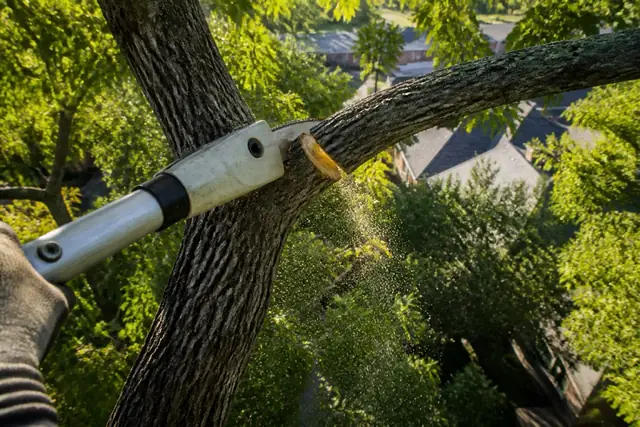
North Collin Tree Pros puts McKinney property owners in touch with a local tree service provider for tree trimming & pruning in McKinney and the north Collin County towns around it.
Good pruning is mostly subtraction done in the right places. Deadwood comes out because it will fall on its own schedule otherwise. Crossing limbs come out because bark rubbed raw is an entry wound. Weight comes off the ends of long, heavy laterals rather than out of the interior, because a hollowed-out crown with a tuft of foliage on the tips is weaker than the tree was before anyone touched it. Every cut lands just outside the branch collar, where the tree already has the machinery to seal itself.
The calendar carries unusual weight in this part of Texas. Texas A&M Forest Service asks that oaks not be pruned or wounded from February through June, when sap beetles are moving and fresh wounds are most attractive to them, and asks that every oak wound be painted immediately in any season. That single rule reshapes the year: structural work on live oak, post oak, and red oak gets scheduled for the winter or the back half of summer, while elms, pecans, and ornamentals can be worked in the shoulder months.
Species behave differently enough here that a generic trim spec does not survive contact with the yard. Cedar elm sheds interior twigs constantly and needs cleaning more than thinning. Bradford and Cleveland pears carry narrow, included-bark unions that split under ice, so the work is weight reduction before the storm, not repair after it. Crepe myrtles get butchered every February by people who think the stubs are a technique; they are not, and a crepe myrtle recovers its shape faster from selective thinning than from a row of knuckles.
Frequency is a budget question with a real answer. A young shade tree benefits from light structural work every two or three years, which is cheap while the cuts are small. A mature post oak may need nothing but deadwood removal for a decade. Clearance pruning over a roof or a driveway usually runs on a three-to-five-year cycle depending on growth rate. Anyone proposing to prune everything on the lot every single year is selling frequency rather than horticulture.
The February-through-June rule, in plain terms
Oak wilt is a fungal disease that moves two ways: overland, when sap beetles carry spores from a fungal mat on a dead red oak to a fresh wound on a healthy one, and underground through grafted roots. The overland route is the one a pruning schedule can shut down. Texas A&M Forest Service's oak wilt prevention guidance names February through June as the window to avoid wounding oaks, and asks that any oak wound — pruning cut, storm break, mower strike, construction scrape — be painted immediately, in every season.
Painting a cut is otherwise unnecessary and mildly counterproductive on most species, which is why the instruction confuses people. On oaks in Texas it is not about healing; it is about denying a beetle a scent trail for the few hours the wound is fresh. Tool sanitation belongs in the same habit: a ten percent bleach rinse between trees costs nothing and closes another route.
Everything else in a pruning spec follows conventional practice. The International Society of Arboriculture's guide to pruning your trees explains cut placement, dose limits, and why removing more than about a quarter of a live crown in one season is a stress event rather than a haircut.
Topping, lion-tailing, and the two habits that shorten a tree's life
Topping — cutting a crown back to stubs — produces exactly what it looks like it produces: a flush of weakly attached water sprouts from latent buds, growing fast and anchored badly, on a trunk now carrying large open wounds it cannot compartmentalize. Five years later the tree is taller than it was, denser than it was, and structurally worse than it was. The state forest service's pruning notes cover why the practice keeps reappearing and why it keeps failing.
Lion-tailing is the quieter version of the same mistake. Stripping the interior of a limb and leaving foliage only at the tip moves the lever arm outward and takes away the taper that let the branch flex. It looks tidy from the driveway. It also makes the limb far more likely to fail in the next gust, which in this county arrives with the first big spring line of storms.
The counterweight to both habits is knowing what a mature tree actually needs, which is usually less intervention and more soil care. The ISA's mature tree care notes make the case that root-zone protection and correct watering do more for an old tree than any amount of crown work.