 North Collin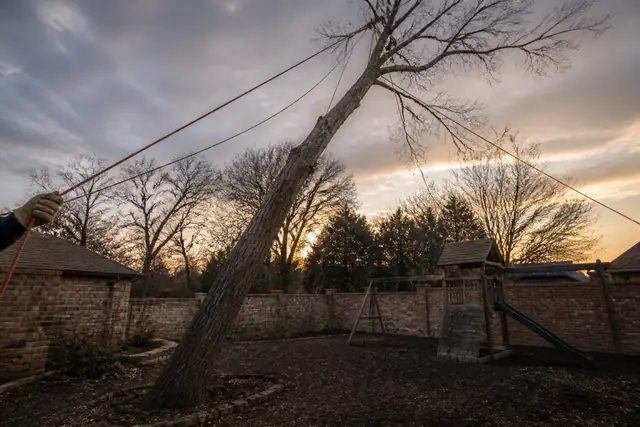
North Collin Tree Pros puts McKinney property owners in touch with a local tree service provider for dead & hazardous tree removal in McKinney and the north Collin County towns around it.
Hazard is not a property of a tree. It is the intersection of a defect and something worth protecting. A hollow, half-dead post oak standing alone in a Weston hay field is a wildlife feature; the identical tree leaning over a child's trampoline in Princeton is a job that gets scheduled this week. That is why nobody can price this work from a photograph — the picture shows the defect and says nothing about what is underneath it.
The signs that matter are mostly visible from the ground once you know where to look. Bark sloughing in sheets from a trunk with no new growth behind it. Shelf fungi at the base, which mean decay has already reached structural wood. A crescent of lifted soil on the side opposite a lean. Carpenter ants pouring out of a union. Fine twigs at the crown edge snapping dry instead of bending. Any two of those on the same stem move a tree up the list.
North Texas gives trees a rough ride, and the damage is cumulative rather than sudden. A run of triple-digit summers dries the profile deep into the clay and kills fine roots that never grow back the same way; a wet spring then saturates the top eighteen inches and softens the anchorage that is left. Trees that survived both are frequently carrying decay from a decade-old wound nobody remembers, and they fail in the first serious wind that arrives after all of it.
Triage beats a queue. Where several trees are in question, the useful output of a site visit is an ordered list — this one now, these two before winter, these three watched for a season — rather than a single yes-or-no per tree. That ordering is what turns an intimidating quote into a two-year plan, and it is honest about the fact that not every declining tree is an emergency.
One thing this site cannot do is diagnose from a form. A photo of a dying crown is consistent with drought stress, root severance from a trench, oak wilt, hypoxylon canker, borers, or a construction injury from four years ago, and the treatments diverge sharply. What the form does is get a provider standing at the root flare with a mallet and a probe, which is where the answer actually lives.
Reading a tree from the ground
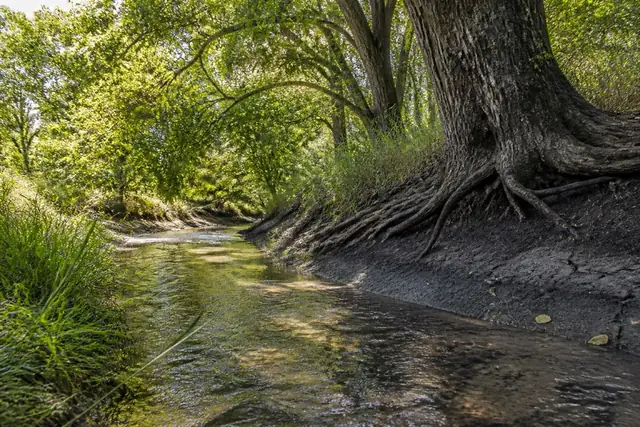
Start at the base and work up, because roots and root collar failures are both the most common and the least visible. Look for soil heave, exposed or severed roots from old trenching, mushrooms fruiting in an arc at the dripline, and a trunk that enters the ground like a telephone pole instead of flaring. The International Society of Arboriculture's tree risk management notes lay out the same sequence in homeowner terms.
On the trunk, the questions are about wall thickness and wound history. A cavity is not automatically fatal — trees compartmentalize, and a sound shell of adequate thickness carries load fine — but a cavity with an opening wider than a third of the stem diameter, or soft wood behind the shell, changes the answer. Texas A&M Forest Service's Can My Tree Be Saved? walks through those thresholds with diagrams.
In the crown, the tell is proportion. Deadwood scattered through an otherwise full canopy is normal shedding. Dieback concentrated at the outer tips across a whole side of the tree points at a root or vascular problem on that side, and that is when a closer look at insects and diseases becomes worthwhile rather than alarmist.
Why saturated ground turns a stable tree into a hazard
Blackland clay holds water at the surface and drains slowly, which is a virtue in August and a liability in a wet April. When the top foot and a half is saturated, the shear strength of the soil around the root plate drops sharply, and a crown that has been catching wind for thirty years without complaint suddenly has nothing holding the other end. State forest service guidance on trees and flooding explains the mechanism and the aftermath, including why a tipped tree rarely re-establishes even if it is stood back up.
The North Texas climate record makes this a recurring rather than exotic risk. Normals for Dallas-Fort Worth over 1991 to 2020 put annual precipitation at 37.01 inches, and the Fort Worth office's normals and records show how unevenly that total arrives — long dry stretches punctuated by storm systems that deliver several inches in a day.
Practical consequence: after a heavy rain, walk the base of any large tree near the house. A crescent of cracked or mounded soil on the uphill side of a lean is the single clearest ground-level sign that a root plate has moved, and it is worth a call the same week rather than the next season.