 North Collin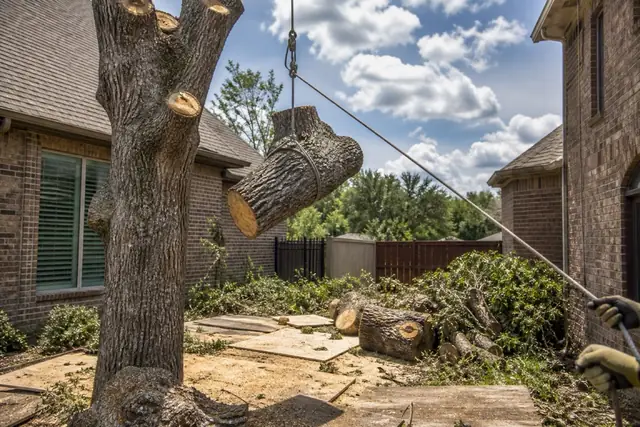
North Collin Tree Pros puts McKinney property owners in touch with a local tree service provider for tree removal in McKinney and the north Collin County towns around it.
Almost nothing in north Collin County gets felled in one piece. The newer McKinney phases put brick walls twenty feet apart, and the older streets east of the square hold post oaks whose limb spread predates the fence line by decades. What that means in practice is a sectional takedown: a climber or a bucket sets rigging in the crown, wood comes off in controlled pieces, and each piece is lowered rather than dropped. The tree does not decide where it lands — the rigging does.
Whether a removal needs paperwork depends entirely on the address. McKinney administers tree removal and permit questions under Section 404A of its Unified Development Code, with applications routed through the city's Citizen Self Service portal, and the surrounding towns each run their own ordinance on their own thresholds. A property three streets over may sit in a different jurisdiction with a different answer. The honest first step is a look at the parcel and a call to the governing city, not a rule of thumb repeated off a website.
Ground condition drives more of the day than most people expect. Blackland clay carries a truck fine in February and turns to grease after a two-inch rain, and by late August it has opened shrink cracks wide enough to swallow a tape measure. Plywood or composite mats under the tires are not an upsell on this soil; they are the difference between a lawn that recovers in three weeks and ruts that need topsoil and reseeding. Access matters just as much — a gate width of thirty-six inches decides whether a mini loader can reach the back yard or whether every stick walks out by hand.
A written removal price should separate at least four things: the takedown itself, debris processing, haul-off, and anything left in the ground. Bundling all of it into one number is how disputes start. Diameter is only part of the math; a forty-inch pecan over open pasture is often cheaper than a twenty-four-inch hackberry leaning across a pool cage, because the pecan can be dropped and the hackberry has to be dismantled piece by piece over water.
What the site looks like afterward is worth agreeing on in advance. Chips can stay as mulch for beds, go to the curb, or leave on the truck. The stump can be cut flush, ground to a shallow depth for turf, or taken deep enough to plant into. Roots close to the surface may need a separate pass. Getting those choices onto the quote in writing is the simplest way to avoid a second invoice.
Why the drop zone decides the price
Bid a tree by trunk diameter alone and you will be wrong about half the time. The variable that actually moves the number is whether there is somewhere for wood to fall. On an acre in Weston with hay pasture on three sides, a large tree can be notched and put on the ground in minutes. On a zero-lot-line street in Frisco, the same tree is fifty separate lifts, every one of them rigged, and the fence, the gas meter, and the neighbor's patio cover are all inside the fall radius.
Overhead conductors change the calculation again. Utility clearance work near energized lines is a separate discipline with its own rules, and the sensible move is to have the utility de-energize or cover the span before anyone works within reach of it. The International Society of Arboriculture's homeowner guidance on trees and utility conflicts is blunt about the same point: this is not a place for improvisation, and it is not a place for a ladder.
Buried infrastructure sets the last constraint. Texas law requires an 811 notice before moving earth deeper than sixteen inches, and the Railroad Commission's damage prevention program explains the rule and the exception-free habit worth adopting: locate first, dig second. Stump work, root pruning, and outrigger pads all touch that threshold.
The stump, the roots, and what goes back in the hole
A removal is not finished when the trunk is on the truck. Grinding depth should match the plan for the ground: four to six inches is enough to lay sod over, ten to twelve inches is what a new tree wants, and anything involving a slab, a footing, or a fence post needs a conversation about surface roots that run well past the stump itself.
The grindings are acidic, nitrogen-hungry, and full of wood — fine as a path surface or a bed mulch, poor as backfill under turf. Texas A&M Forest Service's guidance on mulching around trees covers what a wood layer does and does not do for soil, and the same logic applies to a fresh grinding pile. If a replacement tree is going in the same spot, the usual answer is to haul the grindings off and bring in native soil rather than fight the nitrogen draw for two seasons.
Replanting deserves a beat of thought rather than a reflex. The planting guide from the state forest service walks through species choice and root-flare depth, and on Blackland clay the depth question matters more than the species question — a tree set two inches too deep in this soil is a slow failure nobody notices until year four.