 North Collin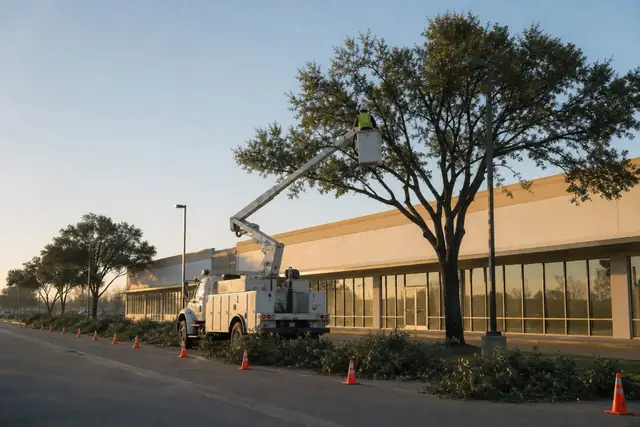
North Collin Tree Pros puts McKinney property owners in touch with a local tree service provider for commercial tree care in McKinney and the north Collin County towns around it.
Commercial tree work is a different problem from residential tree work, and the difference is scale rather than difficulty. A retail center on a north Collin arterial may have two hundred trees across a parking field, a detention area, and a landscaped frontage, in every condition from newly planted to structurally finished. Handling that one call at a time produces a decade of reactive spending. Handling it as an inventory produces a budget.
An inventory is simply a list with attributes: location, species, approximate size, condition, and any defect worth noting, ranked into priority tiers. Tier one is anything with a target underneath it — a limb over a parking stall, a declining tree beside a walkway. Tier two is clearance and maintenance work with a deadline attached. Tier three is everything that can wait a season without consequence. Most properties are surprised by how small tier one turns out to be.
Clearance is the recurring commercial job. Canopies get raised off delivery routes and parking stalls to give trucks room, off pole lighting so the lot is actually lit at night, and away from signage sightlines and building façades. On a property with mature live oaks and cedar elms across a wide lot, that is a predictable three-to-five-year cycle rather than an emergency, and pricing it as a cycle is materially cheaper than pricing it as a series of surprises.
Access windows shape the work more than anything else. A grocery frontage is worked before dawn. A medical office wants nothing running during patient hours. An HOA common area needs residents notified and parking cleared. School-adjacent property gets worked when the property is empty. None of that is complicated, but all of it has to be in the scope, because a bucket truck that cannot deploy is an expensive way to spend a morning.
Construction on a commercial site is where the real money is lost quietly. Trees on a property being expanded or resurfaced are exposed to trenching, stockpiles, and equipment traffic in their root zones, and the resulting decline surfaces years later as a removal budget nobody planned. Protection fencing at the dripline, a designated equipment route, and a written no-storage zone cost very little compared with replacing a mature canopy.
Turning two hundred trees into a three-year budget
The inventory does the work. Once each tree carries a condition rating and a priority tier, the annual line item stops being a guess: tier one this quarter, tier two spread across the year, tier three reviewed next season. The urban forestry program at Texas A&M Forest Service exists around exactly this idea — that a managed canopy is a maintained asset rather than a recurring surprise.
Priority ranking uses the same logic as any risk framework: a defect matters in proportion to what sits beneath it and how often anything is there. A dead limb over an employee entrance outranks a worse limb over a detention pond. The ISA's tree risk management notes set out that reasoning in a form that is easy to hand to a board or a property manager.
Species composition is worth reviewing as part of the same exercise. Lots planted heavily to a single species carry correlated risk, and replacements on this ground should favor species adapted to alkaline clay rather than whatever the original landscape plan specified from a wetter region.
Protecting canopy through a construction phase
Most commercial tree loss is not caused by storms; it is caused by projects. A trench cut across a root zone for conduit, a stockpile parked under a canopy for a month, an equipment route that becomes a compacted lane — each is invisible on the day and decisive three years later. The USDA Forest Service urban forests program frames the same problem at the scale of a whole developed landscape.
Protection is cheap and specific: fencing at the dripline rather than the trunk, a written no-storage and no-traffic zone inside it, root pruning done cleanly with a saw where a trench is unavoidable rather than torn by a bucket, and mulch inside the fence to buffer what traffic does occur. On oaks there is a further rule — any wound, from any cause, gets painted immediately, and the February-through-June window is avoided where the schedule allows, per state oak wilt guidance.
Where the property sits inside McKinney, soil-disturbing and grading work also runs through city review; the city's engineering department is the point of contact, and the neighboring towns each maintain an equivalent. Building the tree-protection plan into that submission is far easier than retrofitting it.