 North Collin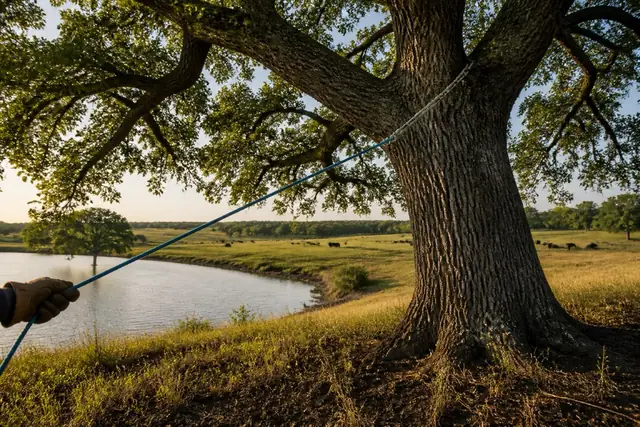

North Collin Tree Pros puts Parker property owners in touch with a local tree service provider for tree removal, pruning, stump grinding, and storm work across Parker.
Parker has held onto its large-lot pattern deliberately, with current planning material stating that future development generally uses a two-acre minimum lot size. What that produces is a landscape of ranch-style homes on rolling ground, scattered old bur oaks that were left standing when the land was grazed, stock ponds with a ring of bottomland trees around them, and long private drives between all of it.
The city is also one of the places in this county that names branch clearance over public roads directly in its ordinance rather than leaving it to complaint. That distinction is worth knowing if a property fronts a city street with low limbs over the pavement, because it turns a discretionary trim into a defined obligation with a defined dimension.
The old open-grown bur oaks are the specimens worth the most attention. A tree that developed in pasture spreads wide, low, and heavy, with long horizontal limbs carrying enormous end weight and frequently a codominant union or two from the days when nothing shaded its leader. Those are exactly the structures that fail under ice, and they are also the trees that no planting decision replaces inside a human lifetime.
Around the stock ponds the picture changes within fifty feet. Ground stays wetter, the species shift toward pecan, cottonwood, and willow, and anchorage is less reliable after a wet spell than the same species on the upland behind it. Trees at a pond edge earn a look after any prolonged rain, particularly the ones leaning out over water where a failure is easy to ignore until it is not.
Old pasture oaks and the weight they carry
An open-grown bur oak has a shape no forest tree develops: low branching, wide spread, and horizontal limbs reaching thirty feet or more from the trunk. Each of those limbs is a lever, and the end weight on it is what fails first under glaze. Reduction pruning at the tips shortens the lever without gutting the crown, and Texas A&M Forest Service's pruning guidance explains why that beats removing interior wood.
Where a union is already suspect, support hardware becomes the conversation — always after inspection, never as a default. The state's Can My Tree Be Saved? guide covers the crown, trunk, and root conditions that make a specimen a reasonable candidate versus one that should come down.
Ice is the load these trees are being protected against. Dallas-Fort Worth normals list only 1.6 inches of annual snowfall for 1991 to 2020, which understates the real hazard; the Fort Worth weather office event archive carries the record of glaze events that actually break North Texas crowns.
Clearance over the road, and the pond edge
Parker's branch-height ordinance addresses branch height over public roadways as a defined nuisance provision rather than a matter of taste, which gives a specific dimension to work to when limbs hang over the pavement. Where a property fronts a city street, that is the standard the trimming should meet.
The city's strategic growth material describes the two-acre minimum pattern that shapes future development, which is also why so much of the tree work here happens along private drives and fence lines rather than in back yards.
At the water's edge, anchorage is the thing to watch. Texas A&M Forest Service's trees and flooding guidance explains how saturated soil undercuts a root plate, and a pond-side tree leaning further out over water after a wet spring is the classic case that gets ignored until it fails.