 North Collin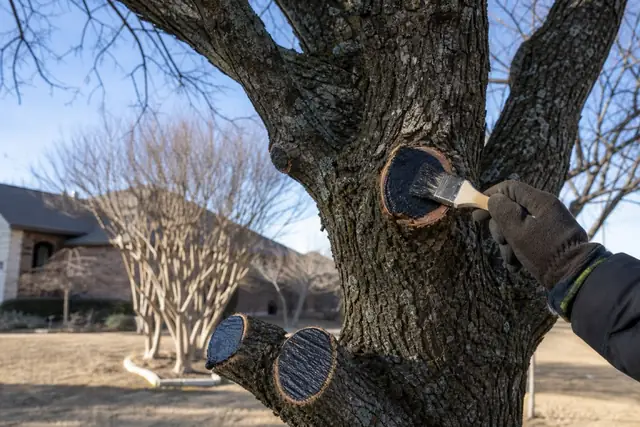

North Collin Tree Pros puts McKinney property owners in touch with a local tree service provider for oak wilt prevention & oak care in McKinney and the north Collin County towns around it.
Oak wilt is a fungal disease of the water-conducting tissue, and it moves in two ways that call for two different responses. Above ground, sap beetles carry spores from fungal mats forming on dead red oaks to fresh wounds on healthy oaks. Below ground, the fungus travels through roots that have grafted between neighboring trees of the same species. Nearly everything a homeowner can do addresses the first route, and the second is why a confirmed case becomes a neighborhood problem rather than a single-tree one.
The prevention rule is a calendar and a paint can. Texas A&M Forest Service asks that oaks not be pruned or wounded from February through June, when beetle activity and mat formation overlap, and asks that every oak wound be painted immediately regardless of season — pruning cuts, storm breaks, mower strikes, construction scrapes, all of them. On most species wound paint is unnecessary; on Texas oaks it is a beetle deterrent, and the window between a fresh cut and a sealed one is measured in hours.
Susceptibility differs by group, which shapes what you watch for. Red oaks — Shumard, Texas red oak, blackjack — are hit hardest and can brown and drop an entire crown within about a month of infection, and it is dead red oaks that produce the spore mats that spread the disease overland. Live oaks are intermediate and typically decline over a longer period, with leaves showing veinal necrosis: veins yellowing or browning while the tissue between stays green. White oaks, including post oak, are least susceptible but not immune.
Where a pocket is already established, management gets physical. The root-graft route advances roughly seventy-five feet per year, and the standard barrier is a trench cut at least a hundred feet outside the dripline of the nearest symptomatic tree and at least four feet deep to sever the connections. That is real excavation, it needs an 811 locate first, and it only works if the line is placed ahead of the spread rather than beside it.
The homeowner list is short, unglamorous, and genuinely effective. Keep oak firewood where it was cut and never move it to another property. If a red oak dies, deal with the wood promptly rather than leaving it to form mats through the winter. Paint every oak wound the moment it happens. Rinse pruning tools between trees. And when several oaks in one block start declining together, treat it as a shared problem and get a sample confirmed rather than each neighbor guessing separately.
What the calendar is actually protecting against
The February-through-June window exists because two things line up in it: fungal mats forming on red oaks that died the previous season, and sap beetles moving between them and any fresh wound they can find. Cut an oak in April and the wound is a target for as long as it smells like one. The Texas A&M Forest Service oak wilt guidance sets out the window and the immediate-painting rule together, because neither works well without the other.
Recognition matters as much as prevention, since the treatment window closes fast on a red oak. The Texas Oak Wilt Partnership's identification pages describe the symptom pictures for each oak group, including the veinal pattern on live oak that distinguishes it from ordinary drought decline.
Painting oak wounds is the part that draws argument, because it contradicts the general rule that wound dressings do more harm than good. The distinction is purpose: on Texas oaks the coating is a scent barrier during the hours a wound is attractive, not a healing aid, which is why the state guidance applies it to storm damage and scrapes as well as to pruning cuts. The ISA's broader pruning notes cover the general case for everything that is not an oak in Texas.
If it is already in the neighborhood
A confirmed pocket is managed with a trench, and the numbers are specific: at least one hundred feet outside the dripline of the nearest symptomatic tree, at least four feet deep, placed ahead of the advancing front rather than at it. The management guidance from the Oak Wilt Partnership covers barrier placement and the follow-up work, including why a trench cut too close accomplishes nothing.
Excavation on that scale is regulated work. Texas law requires an 811 notice before earth is moved deeper than sixteen inches, and the Railroad Commission damage-prevention program covers the requirement and the practical sequence. Four feet of trench across a suburban block touches essentially every buried service on the street.
Dead red oaks are the other half of the response. Because they are the mat producers, wood from a red oak that died of the disease gets handled promptly rather than stacked for next winter, and it does not travel to another property. Chipping, burying, or burning it on site all close the same door.