 North Collin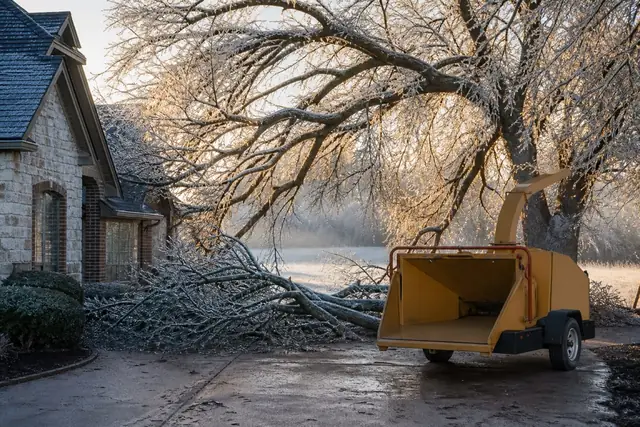
North Collin Tree Pros puts McKinney property owners in touch with a local tree service provider for emergency & storm tree removal in McKinney and the north Collin County towns around it.
This is ice country, not hurricane country, and the difference shapes everything about storm work here. Dallas-Fort Worth normals for 1991 through 2020 list just 1.6 inches of annual snowfall, which undersells the real hazard: a quarter inch of freezing rain glazing every twig can add hundreds of pounds to a crown that was balanced for wind, not weight. Bur oak, hackberry, and ornamental pear are the usual casualties, and the failures arrive at three in the morning with a sound nobody who has heard it forgets.
The first hour after a failure is about hazards, not cleanup. A limb resting on a service drop is an energized limb. A trunk under load has stored energy that releases the instant a saw reaches the compression side. Texas A&M Forest Service is unambiguous that limbs on or near power lines are not a homeowner's job, and the same guidance asks people to stay clear until the utility has cleared the span. Everything else — the driveway, the fence, the shed roof — will still be there in daylight.
Once the site is safe, triage runs in a fixed order: anything touching a structure or blocking egress, then anything hanging that could fall on a person, then anything on the ground. Hangers are the ones people underestimate. A broken limb caught in the crown can sit for a week and come down in a five-mile-an-hour breeze, and clearing it usually means climbing or a bucket rather than a pole saw from the lawn.
Storm scope is easy to get wrong in writing, and worth getting right. A clear emergency quote separates the make-safe visit from the full cleanup, because they often happen on different days with different equipment. It says whether the price includes cutting a trunk into rounds and leaving them, or removing them. It notes whether roof or fence repair is somebody else's trade. Photographs before anything moves are worth taking whether or not a claim is ever filed.
Resist the urge to judge a damaged tree in the first week. State forest service guidance on ice damage asks people to wait for spring growth before writing off a tree that looks ruined in January, and to delay cosmetic pruning until the structure can be assessed against what actually leafs out. A tree that lost a third of its crown to ice often recovers. One that split through the union usually does not, and the difference becomes obvious in April rather than in the dark with a flashlight.
What ice actually does to a North Texas crown
Freezing rain does not load a tree evenly. It coats the fine outer twigs first, which is precisely the part of the lever arm with the least ability to carry weight, and it keeps loading as long as surface temperatures stay below freezing while the air above is warmer. The National Weather Service event archive at the Fort Worth office keeps the running record of these events, and the pattern in North Texas is a handful of significant glaze episodes per decade rather than an annual certainty.
Species susceptibility is not random. Trees that hold leaves late, carry included bark at their unions, or grew fast in open subdivision conditions break first. Texas A&M Forest Service's cold and ice damage notes describe the aftermath work in detail, including the instruction to paint each oak cut before making the next one and to rinse saw chains and hand tools with a ten percent bleach solution between trees.
The other half of storm season is straight-line wind and the occasional saturated-ground failure, where the tree does not break but tips with its root plate intact. The forest service's trees and flooding guidance covers why waterlogged soil undoes anchorage that held for forty years, and why a leaning trunk with lifted soil behind it is treated as an emergency rather than a wait-and-see.
Sorting an emergency from an expensive Saturday
Genuinely urgent: contact with a structure, contact with any conductor, a blocked exit, a hanging limb over a walkway, or a fresh lean with heaved soil. Everything on that list justifies an after-hours rate. Not urgent: a downed tree lying flat in the back forty, a pile of small limbs, or a stump. Those price better on a normal weekday, and a provider who says so is telling you something useful about how they quote.
Documentation is cheap and occasionally decisive. Photograph the damage from several angles before anything is cut, note the date, and keep the written scope. If an insurer is involved, the paperwork is what they read; if one is not, the scope is still what keeps a verbal agreement from drifting.
For the wait-and-see cases, the state forest service publishes Can My Tree Be Saved?, a short assessment guide that walks through crown loss, trunk wounds, and root damage in terms a homeowner can apply from the ground. It is the most useful thing to read before deciding whether a storm-hit tree gets another season.