 North Collin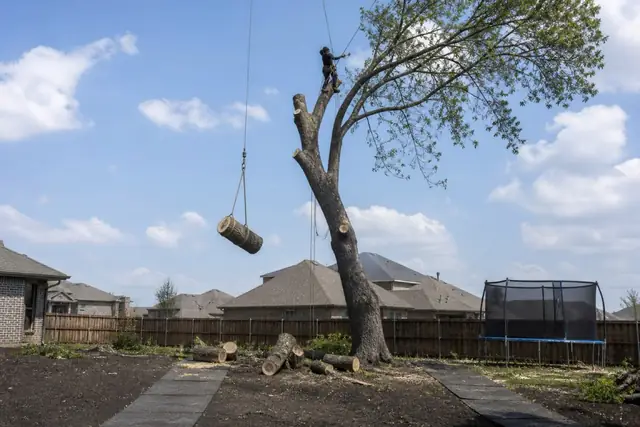

North Collin Tree Pros puts Princeton property owners in touch with a local tree service provider for tree removal, pruning, stump grinding, and storm work across Princeton.
Princeton grew along a highway corridor rather than around a square, and the result is a patchwork: new brick subdivisions next to older lots with volunteer hackberry and cedar elm that were never planted by anyone. The two produce completely different work. New yards need establishment care and structural pruning; the older lots need deadwood, storm-damage repair, and honest conversations about trees that grew up unmanaged.
The city's planning function regulates development and coordinates services with Collin County, and its published maps distinguish city limits from the extraterritorial jurisdiction that surrounds them. That boundary genuinely matters for tree work: which office reviews a grading project, and which rules apply to a lot, depends on which side of the line the parcel falls. Checking the map before assuming is a two-minute step.
Hackberry deserves a paragraph of its own because it dominates the unmanaged lots here. It seeds anywhere, grows fast, and builds weak, brittle wood with unions that fail young, which is why it is disproportionately represented in the pile after every wind event. It is not worthless — it holds a bank, shades a fence line, and feeds birds — but it is rarely the tree to build a yard's future around.
Storm work is a regular feature rather than an exception. This part of the county gets the same spring convective line as everyone else, and the combination of fast-grown volunteer trees and open exposure means limbs come down more often than in a neighborhood of managed canopy. The useful preparation is pre-season: get the deadwood out and the worst unions reduced before the weather rather than after.
City limits, ETJ, and who reviews what
The city's planning and zoning function regulates development inside the limits and coordinates with Collin County beyond them, and its published maps draw the distinction explicitly. For a homeowner, the line usually matters when work involves grading, a driveway, or anything that needs review — not for routine pruning.
Where a parcel sits in unincorporated territory, county-level rules and services take over, and Collin County is the right starting point for that side of the question. It is a different set of offices and a different set of answers.
Either way, excavation depth triggers the same statewide rule: the Railroad Commission damage-prevention program requires an 811 notice before earth is moved past sixteen inches, regardless of which jurisdiction reviews the project above ground.
Living with volunteer hackberry
Hackberry is the most successful volunteer tree in this county and one of the least structurally sound. Fast growth produces low-density wood, and unmanaged specimens develop codominant stems and included bark that fail in wind long before the tree reaches old age. Where one is close to a house, the sensible move is reduction and deadwooding on a schedule rather than waiting for the storm to decide.
Assessment is worth doing properly on a mature volunteer, because the answers vary widely. The ISA's tree risk management notes give homeowners the vocabulary for what to look at, and the state forest service's Can My Tree Be Saved? guide gives a framework for deciding whether to invest in a tree or replace it.
Where a replacement is going in, choosing something adapted to alkaline clay saves a decade of disappointment. The state's planting guidance covers depth, species, and the establishment years that determine everything afterward.