 North Collin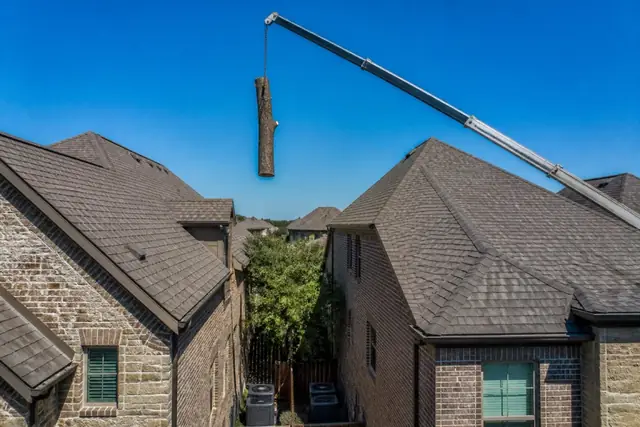

North Collin Tree Pros puts McKinney property owners in touch with a local tree service provider for crane-assisted tree removal in McKinney and the north Collin County towns around it.
A crane earns its keep where there is nowhere to put wood. That describes a great deal of the housing built north of McKinney in the last fifteen years: two-story brick homes on lots narrow enough that the side yard is a walkway, back fences shared on three sides, and a mature tree in the middle of it that predates the subdivision. Rigging every piece down through that space is possible and slow. Flying it out over the ridgeline is faster and, done properly, touches nothing on the way.
The plan is written before the truck rolls. Where the crane sets up decides everything downstream: outrigger pads need bearing capacity, and Blackland clay after rain does not have it without cribbing. Radius from the pin to the tree sets the chart capacity, and capacity falls off fast as the boom reaches out. Every pick gets estimated for weight before it is cut, because a green pecan round is heavier than most people's intuition and the chart does not negotiate.
A crane is not automatically the safer answer. It concentrates a great deal of mass over a house, needs overhead space that many older streets do not have, and introduces a whole class of failure modes that a climbing removal simply does not have. Where a tree can be dismantled conventionally with adequate rigging points and a place to lower to, that is usually the better job. The crane belongs to the cases where the alternative is worse.
On cost, the honest framing is a trade rather than a premium. A crane carries a day rate and a smaller ground component; a conventional removal carries no machine rate and many more labor hours. For a large trunk with no access, the crane job frequently finishes in a day where the rigged version takes three, and the totals land closer together than the hourly rates suggest. Ask for both approaches priced when the site could go either way.
What a lift plan has to account for
Four things, in order: ground bearing under the outriggers, boom path from the setup to the tree and back to the landing zone, the weight of each pick against the chart at that radius, and where people stand while a load is in the air. Overhead conductors are the constraint that most often kills a crane plan on older McKinney streets, and the ISA's guidance on trees and utility conflicts notes explain why clearance distances are non-negotiable rather than advisory.
Ground preparation is the part homeowners see and misread as damage. Cribbing and steel plate under an outrigger is not carelessness; it is what keeps a machine from settling into clay that looked firm on a dry morning. The Natural Resources Conservation Service resources on soil behavior describe why shrink-swell clay changes bearing capacity so sharply with moisture, which is exactly the property that matters here.
Utilities below matter as much as those above. Setting outriggers or cutting a pad involves earth movement, and Texas law requires an 811 notice past sixteen inches of depth, as the state damage-prevention program sets out. On a tight lot the crane pad, the stump, and the access route are all in play.
When to say no to the crane
Three common cases. Overhead lines that the utility will not de-energize or cover; a setup position that would put the boom over a neighboring house without permission; and a tree so decayed that the pick points cannot be trusted to hold a load. In that last case the safer job is a bucket and a lot of small pieces, and a provider who volunteers that is worth listening to.
There is also the ordinary case where a crane is simply unnecessary. A large tree with a genuine drop zone, or one with sound rigging points and a clear lowering path, does not need a machine. Texas A&M Forest Service's general tree care material makes the broader point: the right method is the one the site allows, not the most impressive one available.
Where the tree is worth keeping, the crane conversation ends before it begins. An assessment that concludes with reduction pruning and root-zone repair instead of removal is a better outcome for the property, and Can My Tree Be Saved? from the state forest service is the short guide that most often changes that decision.