 North Collin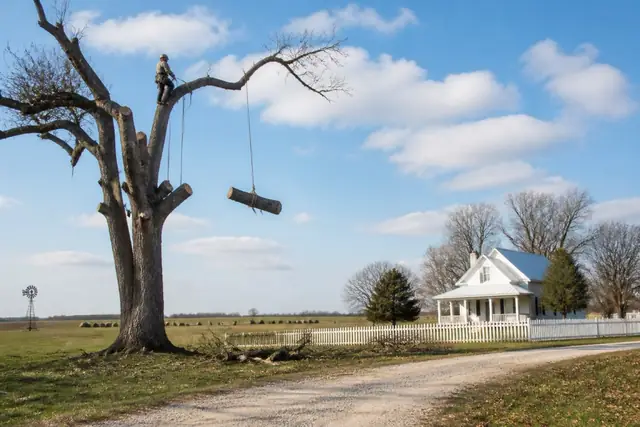

North Collin Tree Pros puts Weston property owners in touch with a local tree service provider for tree removal, pruning, stump grinding, and storm work across Weston.
Weston is the quiet end of this service area — a small rural town whose own map materials identify it as a Collin County municipality with boundary agreements to its neighbors, and whose adopted comprehensive plan covers community vision and future land use for a place that has chosen to stay small. In practice that means farmhouses behind picket fences, hay fields to the horizon, and a handful of very old trees per property rather than a canopy.
The trees that matter here are usually the yard oaks: one or two post oaks or bur oaks planted or spared beside a house generations ago, now hollowing, shedding limbs, and standing over a metal roof or a gravel drive. There is nothing else nearby to replace their shade, which makes the assess-or-remove decision genuinely consequential rather than routine. It also makes protecting the healthy ones worth real effort.
Wide-open exposure defines the mechanical stresses. No surrounding canopy means every tree takes the full spring wind and the full winter glaze, and an old specimen with a codominant union or a decayed lower limb has nothing sheltering it. The upside is access: a property with hay pasture on three sides is the easiest site in this whole service area to work, and prices reflect it.
Fence wire is the small local complication worth mentioning to anyone quoting. Old barbed wire grown into a trunk, a hidden T-post inside a fencerow tree, or a strand buried under callus wood will stop a chain in an instant and ruin a bar. Flagging what you know about before the saw arrives saves time and money, and on a property that has been fenced and re-fenced for a century, there is usually something.
One or two old trees, and what they are worth
On a rural property with no surrounding canopy, a single mature oak is doing all the work — shading the house, holding the yard together, and providing habitat that nothing else on the parcel offers. That changes the calculus of an assessment. Texas A&M Forest Service's Can My Tree Be Saved? guide is the right framework for deciding whether a declining specimen has years left in it.
Where the tree is sound but stressed, the interventions are ordinary and effective: mulch out to the dripline instead of mown grass, deep infrequent water through dry spells, and no equipment or storage inside the root zone. The ISA's mature tree care notes cover the whole regimen for an old specimen worth keeping.
The town's own map material identifies it as a Collin County municipality and describes its boundary agreements, which is the starting point for any question about which jurisdiction reviews work on a given parcel out here.
Wire, wind, and working a wide-open site
Fence wire grown into trunk wood is a genuine hazard rather than an inconvenience, and it is common on any property that has been fenced for decades. Flagging known wire, T-posts, and old staples before work starts protects both the saw and the person holding it. On a fencerow tree, assume something is in there until proven otherwise.
Exposure is the other rural constant. With no windbreak, an old tree carries the full load of every spring line and every glaze event, and the significant weather event record from the Fort Worth office is a reminder of how regularly those arrive in this part of Texas. Deadwood and end-weight reduction before the season beats emergency work during it.
What the open ground gives back is efficiency. A tree that can be felled into pasture and cut where it lands takes a fraction of the time of the same tree in a subdivision, and material can be chipped on site or left in rounds. The state forest service's oak wilt material covers the disposal question, including why oak firewood stays on the property it was cut on.