 North Collin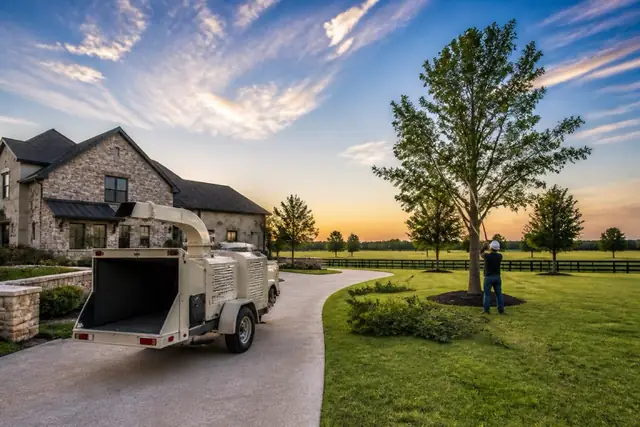

North Collin Tree Pros puts Prosper property owners in touch with a local tree service provider for tree removal, pruning, stump grinding, and storm work across Prosper.
Prosper is a town that straddles the Collin-Denton county line, and its development pattern reflects the ranchland it was built on. Estate lots of an acre or more still carry the bones of the pasture: a line of hackberry and cedar along an old fence, a solitary bur oak that was left standing because cattle grazed around it, a stock pond edge grown up in willow. What happens to those remnants is usually the first tree decision a new owner makes.
The town's Unified Development Code requires a tree permit in covered situations and distinguishes protected trees from others, with exceptions that apply to some single-family lots of record. That last clause is where people get into trouble in both directions — assuming they need a permit for a limb, or assuming they need nothing for a mature tree. The document is public and the town's development staff answers the question; both are faster than guessing.
Young landscape trees dominate the newer phases, and structure work now is worth more than anything that can be done later. Live oak in particular tends to throw multiple competing leaders when it is grown open and watered generously, and left alone that becomes a broad, top-heavy crown on weak unions. Subordinating the competitors over two or three seasons while the cuts are small produces a tree that survives ice storms rather than one that needs steel.
Access on an acre is a genuine advantage and worth using. Long drives, open side yards, and open ground on at least one side mean a chipper can set up close, wood can be dropped rather than rigged, and prices come down accordingly. The counterweight is that the same open ground turns soft after rain, so scheduling around weather does more for a Prosper lawn than any amount of matting.
What the ranchland left behind
Fencerows are where the invasive and volunteer species accumulate, because birds perch on wire and nothing ever grazed the strip beneath it. Eastern red cedar, hackberry, and a rotating cast of introduced species colonize those lines, and clearing them is usually the highest-value hour on an acre lot. The plant database maintained by Texas Invasives is the reference for identifying what is worth removing rather than simply what is in the way.
The trees worth keeping are the opposite story. A wide-crowned bur oak or a mature pecan that grew in open pasture has a shape that no planted tree will reproduce in a lifetime, and the Texas Big Tree Registry exists partly to make that point about specimen trees around the state. Protecting one of these through a build is worth real planning effort.
Before anything is trenched, grubbed, or ground on acreage, the state damage-prevention rule applies: Texas law requires an 811 notice past sixteen inches of depth, and rural tracts hide old water lines and abandoned services that nobody has a map for.
The town's permit question, answered properly
Prosper's Unified Development Code sets out where a tree permit is required, how protected trees are defined, and which situations are excepted — including provisions that apply to certain single-family lots of record. Reading the actual section beats relying on what a neighbor did, because the exceptions are specific rather than general.
The two-county arrangement is also worth confirming rather than assuming. The town's elections material states plainly that Prosper sits in both Collin and Denton counties, which occasionally matters for county-level records even where the town's own rules apply uniformly.
Where the question is whether a struggling tree is worth the permit process at all, the state forest service's Can My Tree Be Saved? guide is the right first read. It is short, it is written for owners, and it separates the trees worth fighting for from the ones that are already finished.