 North Collin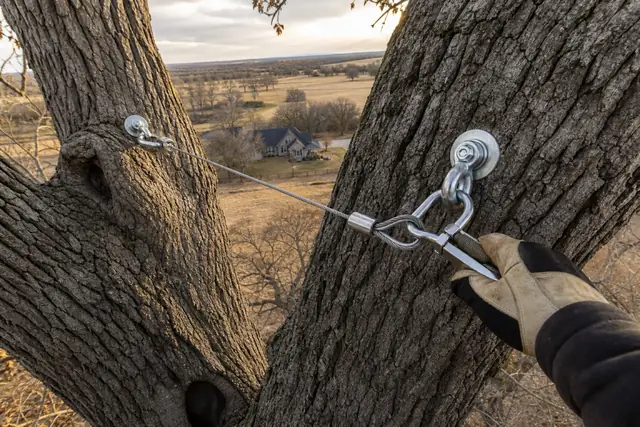
North Collin Tree Pros puts McKinney property owners in touch with a local tree service provider for tree cabling & bracing in McKinney and the north Collin County towns around it.
Support hardware exists for a specific structural fault: two or more stems of similar diameter meeting at a union that never formed proper connective wood. On bur oak, live oak, and pecan across this county that pattern is everywhere, usually with a seam of included bark buried in the crotch where wood should be. The union looks fine from the driveway right up to the February morning it splits under ice.
The two families of hardware do different jobs. A cable set high in the crown restricts how far the stems can travel apart, taking peak load off the union during wind or ice while leaving normal flex intact. A brace rod passes through the union itself and resists the stems being pulled apart at that point — appropriate where a crack has already formed, and never a substitute for the cable above it. Systems are sized to the stems they serve, and oversizing hardware is its own kind of failure.
Nothing about this is permanent. Hardware corrodes, trunks grow around lag anchors, cables slacken as stems settle into a new position, and a system installed a decade ago may now be doing nothing at all. A support installation without an inspection interval attached is half a job. Annual eyes on it, with a closer look after any significant ice or wind event, is the ordinary standard.
The harder conversation is when hardware is the wrong answer. A union with active decay behind it, a stem with a substantial cavity, or a tree whose target zone is a bedroom rather than a lawn may not be a candidate at all. Cabling a structurally compromised tree over a house converts a visible risk into a hidden one, which is worse. The honest recommendation in those cases is reduction or removal, and it should be made plainly.
Included bark, and why the union fails
When two stems grow tightly against each other, bark gets trapped in the join instead of the stems knitting together with structural wood. From outside it reads as a tight V. Inside, it is a seam — a plane of weakness running down into the trunk that grows longer every season as the stems get heavier. Texas A&M Forest Service's pruning material covers how early structural cuts prevent the fault from forming in the first place, which is enormously cheaper than hardware later.
Ice is the local trigger. A quarter-inch glaze loads the outer crown with weight the union was never built to carry, and the seam opens. The Fort Worth weather office's climatology of North Texas describes the winter regime that produces those events, which are infrequent enough that people forget and frequent enough to matter.
Where a young tree still has options, the cheapest fix is a saw rather than steel. Subordinating one of the competing leaders over two or three seasons lets a single dominant stem take over and the fault never develops. The ISA's pruning guide notes describe the technique in homeowner terms.
Living with a supported tree
Three habits keep a system honest. Note the installation date and the hardware locations somewhere you will find them again. Look up after every ice or high-wind event for a slack cable, a bent rod end, or fresh cracking at the union. And keep the inspection on a calendar rather than a memory — annually is the normal interval, sooner on a large tree over a structure.
Support hardware does not reduce the need for ordinary care, and in some ways raises it. A supported tree is by definition carrying a known structural fault, so root-zone protection, sensible watering, and restraint about crown loading matter more than usual. The ISA's mature tree care notes cover the maintenance side of an older specimen.
When the question is whether the tree is worth supporting at all, the state forest service's Can My Tree Be Saved? assessment guide is the right starting point. It walks through the crown, trunk, and root conditions that make a tree a poor candidate before any money is spent on steel.