 North Collin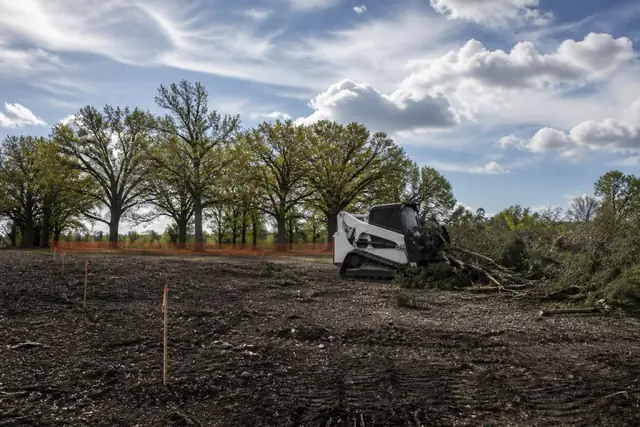
North Collin Tree Pros puts McKinney property owners in touch with a local tree service provider for lot & land tree clearing in McKinney and the north Collin County towns around it.
Clearing an acreage tract north and east of McKinney is mostly a decision about what stays. A parcel that reads as solid brush from the road usually contains a handful of trees worth building around — a wide bur oak, a stand of post oak on higher ground, pecans along a creek bottom — surrounded by eastern red cedar that colonized the fencerows once the pasture stopped being grazed. Walking the tract with flagging tape before any machine starts is the step that determines whether the finished lot looks designed or scraped.
Eastern red cedar is the workhorse of that clearing list for a reason. It seeds aggressively into ungrazed prairie, holds fuel close to the ground, and shades out the grasses underneath. Mixed in with it there is usually a list of introduced species worth removing while the equipment is on site, and Texas Invasives keeps a plant database that makes the identification straightforward. Taking those out during clearing is far cheaper than a separate mobilization later.
Soil is the constraint that decides method and season. Blackland clay compacts badly under repeated tracked passes when wet, and compaction in a future yard is a problem that outlives everyone involved in the clearing. Working in drier conditions, limiting traffic to planned routes, and keeping machines outside the dripline of every keeper tree costs nothing on the schedule and saves the trees the whole exercise was meant to preserve.
Two practical matters belong on every clearing quote. First, the 811 notice: Texas law requires it before earth is moved deeper than sixteen inches, and stump removal, grubbing, and pad prep all qualify. Second, the disposition of material — chipped and spread, stacked for firewood, hauled off, or burned where the governing jurisdiction and current conditions permit it. Burning in particular is not a decision to leave until the day the piles are ready.
Deciding what stays before anything moves
Flag first, cut second. A keeper tree gets tape, a note about its condition, and orange fencing set at the dripline rather than at the trunk — the root zone is what needs protecting, and it extends as far as the branches do and often further. Texas A&M Forest Service's Can My Tree Be Saved? material is the reference for judging whether a candidate is actually worth building around before it becomes the centerpiece of a driveway.
Species matter for that judgement. Post oak is slow, long-lived, and notoriously intolerant of root disturbance; cedar elm and hackberry are tough and forgiving; a fencerow red cedar is rarely worth the space it occupies. The Texas Big Tree Registry catalogues the standing giants of each species around the state and is a useful reminder of what a preserved specimen becomes given fifty undisturbed years.
The invasive list is worth pulling before the machines arrive. The plant database maintained by Texas Invasives covers the introduced species that spread fastest through disturbed North Texas ground, and clearing is the cheapest moment to address them.
Drainage, compaction, and what happens after the machines leave
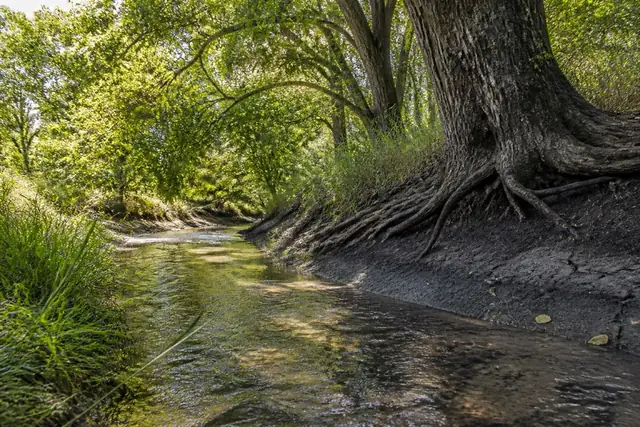
Removing woody cover changes how water moves across a tract, immediately. Bare clay sheds rather than absorbs, and a slope that was stable under brush can start rilling in the first heavy rain. Planning where water goes — and getting cover re-established quickly — belongs in the clearing scope rather than being discovered afterward. The NRCS soils resources explains the erosion and structure side of that in general terms.
Compaction is the quieter damage. Repeated tracked passes over wet Blackland clay collapse pore space in a way that does not recover on any human timescale, and a keeper tree whose root zone was used as a turning area is a tree that will decline five years later for reasons nobody connects to the clearing. Keeping traffic on planned routes is the whole mitigation.
Where the parcel sits inside a city, grading and soil-disturbing work usually attracts review of its own. McKinney's engineering department handles that side for properties inside the city, and the equivalent office in each neighboring town does the same. Confirming the requirement before mobilizing is far cheaper than stopping mid-job.