 North Collin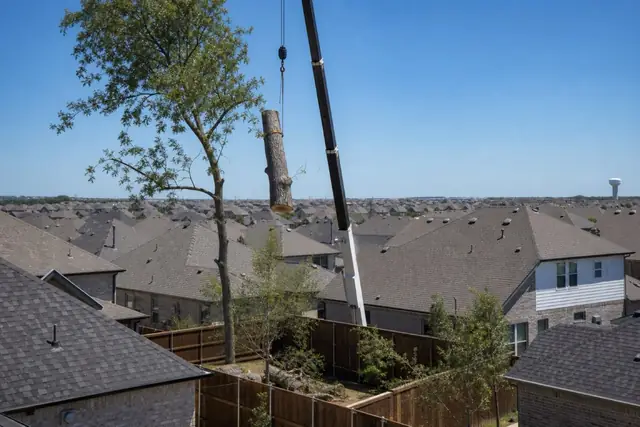

North Collin Tree Pros puts Frisco property owners in touch with a local tree service provider for tree removal, pruning, stump grinding, and storm work across Frisco.
Frisco is the address where the county question has to be asked out loud, because the city spans both Collin and Denton counties. Two houses on the same street can sit under different county jurisdictions, and any conversation about permits, records, or plats that starts with an assumption about which county you are in starts wrong. The reliable sequence is address first, jurisdiction second, scope third.
The building pattern here produces a specific kind of tree job. Lots are narrow, houses are tall, and the space between a two-story wall and a shared back fence is often too small to lower a heavy piece into. Where a legacy hackberry, pecan, or bur oak survived from the pasture that preceded the subdivision, removal frequently means a crane over the ridgeline rather than a climber and a rope, simply because there is no drop zone anywhere on the property.
The rest of the canopy is young and needs the opposite kind of attention. Staked red oaks and live oaks in fresh sod are three to eight years old across large parts of the city, and what they need is structural pruning while the cuts are still small, a mulch ring instead of turf to the trunk, and deep infrequent water rather than the daily sprinkler cycle that keeps the lawn green. Getting that right now avoids the codominant-stem problem that turns into cabling work in fifteen years.
The city treats tree cover as part of development review rather than an afterthought, with tree surveys and preservation plans appearing in its development submittal materials and conservation programming published alongside them. For a homeowner that mostly matters at two moments: buying a lot with existing trees on it, and building anything that puts equipment inside a root zone.
Two counties, one city, and why the address decides
Frisco's municipal limits cross the Collin-Denton county line, which affects county-level records and processes even though the city ordinance applies citywide. The practical rule is simple: give the full street address up front and let the provider confirm jurisdiction against the city's own material rather than guessing from the ZIP code. The city's new resident guide is a reasonable orientation point for anyone new to the arrangement.
Where existing trees are involved in a build or a plat, tree surveys and preservation plans appear in the city's development application materials, and the requirements attach to the project rather than to the tree. That is the document set worth reading before a lot with mature canopy changes hands.
The city also publishes conservation programming that frames canopy as part of the broader environmental picture, which is context worth having when deciding whether to fight for a legacy tree on a tight lot.
Young trees: the cheap work that prevents the expensive work
Almost every structural failure in a suburban shade tree was preventable with a saw when the tree was five years old. Two competing leaders at the top, a narrow union with bark trapped inside it, a limb allowed to outgrow the trunk it attaches to — each is a two-minute cut early and a cabling job or a removal later. Texas A&M Forest Service's pruning guidance covers the principle plainly.
The planting itself is the other half. A root flare buried a few inches below finished grade is the single most common slow killer of young trees on this clay, and no amount of later care undoes it. The state's planting guidance covers depth, staking, and species selection for exactly this situation.
Watering is where good intentions go wrong. New trees in irrigated sod get frequent shallow water near the trunk, which trains roots to stay in the top few inches instead of going down. The ISA's planting a tree notes describe the establishment period and what deep, infrequent soaking actually accomplishes.