 North Collin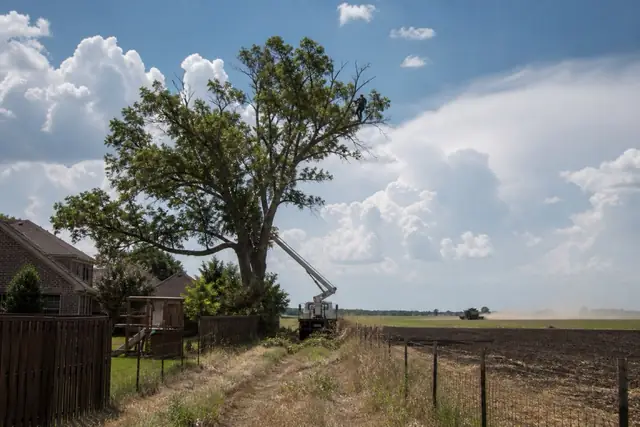

North Collin Tree Pros puts Celina property owners in touch with a local tree service provider for tree removal, pruning, stump grinding, and storm work across Celina.
Celina is the edge, and the edge moves every year. Drive north or west and the last row of a finished subdivision butts directly against working farmland, with an old fencerow of cedar elm and hackberry marking a boundary that predates every house in sight. That transition zone produces most of the tree work here: remnant trees suddenly standing in someone's back yard, and brand-new yards with nothing in them at all.
The city sits in both Collin and Denton counties, which its own financial reporting and election materials state directly. Its zoning ordinance carries landscape and tree-preservation administration for covered development, so the rules that reach a given property usually arrive attached to the subdivision approval rather than to the individual lot. Where an older tree is involved, that history is worth checking before assuming a mature specimen is simply yours to remove.
A remnant fencerow tree in a new yard needs a different conversation than a nursery-grown replacement. It spent its life in the open with a root system spread wide and shallow across pasture, and it has just had a house, a driveway, and a utility trench installed inside that root zone. Deadwooding it and watching the crown for three seasons is often the right call; assuming it will be fine because it looks fine is how these trees die in year four.
For the new yards, the whole job is establishment. Two to four inches of mulch instead of turf against the trunk, a deep soak every several days rather than a daily sprinkler cycle, and light structural pruning at year three and year six. There is almost no shade in a new Celina phase and no way to buy it — the only route is getting these trees through their first decade in good order.
Remnant trees on new lots
A pasture tree absorbed into a subdivision has had its growing conditions changed completely and slowly. The soil around it is compacted from construction traffic, part of its root zone is under concrete, and the grade may have moved. None of that shows immediately, which is why the state forest service's Can My Tree Be Saved? framework is worth applying deliberately rather than waiting for the crown to answer.
What helps is mostly restraint: no more traffic in the root zone, a wide mulch ring in place of turf, deep infrequent water through the first several summers, and no heavy crown work while the tree is already stressed. The ISA's mature tree care notes cover that regimen for an older specimen under pressure.
Compaction is the underlying problem and it does not resolve on its own. The NRCS soils material explains why collapsed pore space in clay restricts root function long after the equipment has left, which is the mechanism behind most delayed construction decline.
Two counties, one city, and rules that arrive with the plat
Celina's own election material confirms the city spans Collin and Denton counties, so county-level questions follow the parcel rather than the city name. It is a small detail that saves a phone call at exactly the wrong moment.
Landscape and tree-preservation administration sits inside the city's zoning ordinance and generally attaches to covered development rather than to routine homeowner maintenance. Where a mature tree was preserved as a condition of an approved plan, removing it later is a different question than removing a tree you planted, and the file is the place that distinction lives.
For new plantings, species choice on alkaline clay matters more than anything done afterward. The Earth-Kind program's regionally adapted plant guidance is a practical filter for what will thrive here versus what will spend a decade looking chlorotic.