 North Collin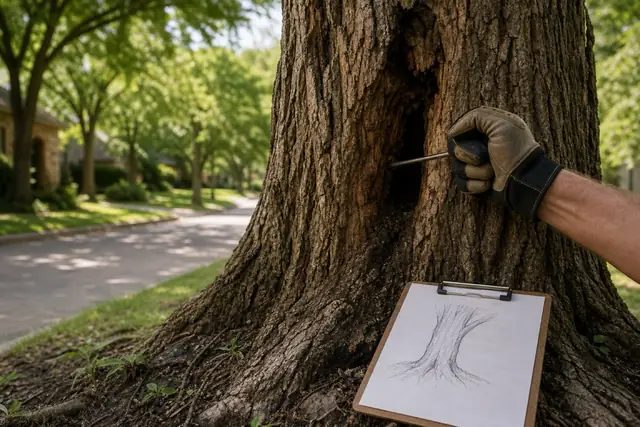

North Collin Tree Pros puts McKinney property owners in touch with a local tree service provider for arborist consultation & risk assessment in McKinney and the north Collin County towns around it.
A consultation is a visit with a deliverable. Someone walks the property, examines each tree of concern at the root flare, the trunk, and the crown, and leaves behind a written list: what was found, what it means, what should happen, and in what order. The value is in the ordering as much as the findings, because almost nobody with several problem trees needs all of them addressed in the same month.
Risk assessment has a structure worth knowing, because it explains why two identical trees get different answers. Three questions get asked about each defect: how likely is the part to fail, what is underneath it if it does, and how bad would that be. A large limb over a driveway that is occupied ten minutes a day is a different risk from the same limb over a bedroom, even though the limb is identical. Treating those the same is how people end up removing trees that did not need removing.
The situations that most often justify a consultation are the ones where a decision is about to be made permanent. A property under contract, where a mature oak is either an asset or a five-figure liability. A build or an addition, where the fencing goes up before the machines arrive or not at all. A neighbor dispute over a limb across a line. A storm that left three trees looking questionable and no way to rank them.
Jurisdiction is part of the deliverable in this county, because it changes what is even possible. McKinney administers tree removal under Section 404A of its Unified Development Code with applications through the city's Citizen Self Service portal, while Prosper, Anna, Melissa, Celina and the rest each run their own ordinances with their own thresholds and exceptions. Knowing which set of rules governs the parcel before planning work is not a formality; it decides the sequence.
It is worth being direct about what a consultation is not. It is not a permit, it is not a legal opinion on a boundary, and it is not a diagnosis that can be produced from photographs. Where a laboratory test or a formal appraisal is needed, the right output is a referral rather than a guess. A consultation that concludes 'monitor this one for a year' is doing its job as much as one that recommends removal.
What gets examined, from the ground up
Roots and root collar first: soil heave, girdling roots circling the stem, old trench scars, fruiting bodies at the base, and whether the trunk flares into the ground or enters it like a post. Then the trunk: cavities, seams, bulges that indicate internal decay, response wood around old wounds. Then the crown: dieback pattern, deadwood distribution, union quality, and the lever arms on long horizontal limbs. The ISA's tree risk management notes describe the same sequence for owners who want to look first themselves.
Species-specific concerns get layered on top. Oaks get checked against the symptom picture for vascular disease, since oak wilt identification can look like ordinary drought decline until the pattern of leaf veins is examined closely. Elms and pecans get a harder look at unions. Anything planted in the last decade gets checked for a buried root flare.
The point of the visit is to produce something you can act on later, which is why the state forest service publishes Can My Tree Be Saved? as a homeowner-readable framework. A written report using the same vocabulary lets you get a second opinion without starting over.
Before you buy the house, or pour the slab
Pre-purchase is the highest-value moment for an assessment, because the price of a large removal is still negotiable. Two or three mature trees over a roof, one with a decayed union, is a real number that belongs in the conversation before closing rather than in year two. It is also the moment to find out what the governing city allows, which for properties inside McKinney means the rules described on the city's tree preservation page.
Construction is the second moment, and it is unforgiving. Root damage from a trencher, an equipment path, or a stockpile in the root zone shows up in the crown three to five years later, long after everyone has left. Fencing goes up at the dripline before the machines arrive or it does not go up at all, and that decision is made in the planning stage rather than on the morning of the pour.
For homeowners deciding whether the visit is worth paying for at all, the ISA's why hire an arborist note is a fair summary of what independent advice buys you — someone whose recommendation does not depend on which piece of equipment they happen to own.