 North Collin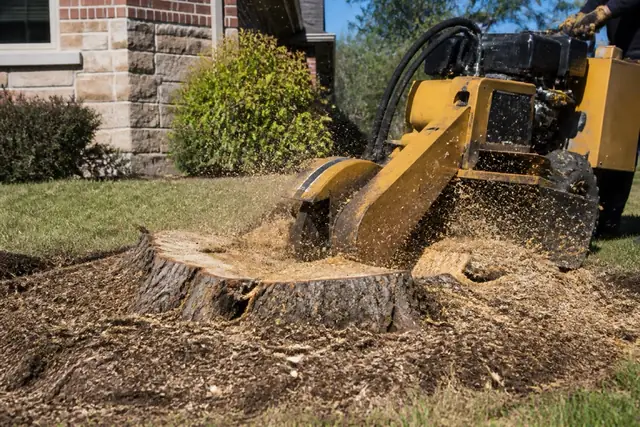
North Collin Tree Pros puts McKinney property owners in touch with a local tree service provider for stump grinding in McKinney and the north Collin County towns around it.
A grinder does one thing: it turns wood below grade into chips using a spinning wheel of carbide teeth. It does not remove the root system, and no honest quote implies otherwise. What varies is depth and spread — how far down the wheel goes, and how much of the surface root flare gets chased outward — and those two numbers should be decided by what the ground is going to be used for rather than by habit.
The utility question comes first on any grinding job. Texas law requires an 811 notice before earth is moved deeper than sixteen inches, and a stump grinder clears that threshold easily on anything bigger than a fence post. Irrigation lines, low-voltage lighting, and shallow gas services are the usual casualties in a north Collin County yard, and none of them show up on a locate ticket the way a distribution main does. Marking sprinkler heads and valve boxes before the machine arrives is five minutes that prevents an afternoon.
Blackland clay complicates the backfill in a way sandy soils do not. Grindings are light, airy, and slow to break down, so a hole packed with them settles for a year or two while the surrounding clay swells and shrinks on its own cycle. The result is the dished spot in the lawn that people blame on the grinder. Hauling the grindings off and backfilling with native soil costs more on the invoice and less in regrading later.
Price tracks diameter measured at the ground rather than at chest height, which surprises people with a flared old pecan, plus access and depth. A stump in an open front yard is a straightforward machine job. The same stump behind a thirty-inch gate means a walk-behind unit and a slower pass, and one wedged between a slab and a retaining wall may need hand work around the edges. Ask for depth in inches on the quote — that single number removes most of the ambiguity.
Depth is a decision, not a default
Four to six inches below grade is enough to lay sod and forget the stump existed. Ten to twelve inches is what a replacement tree needs so its root ball is not sitting on a decaying wood mass. Anything structural — a slab edge, a pier, a fence post, a retaining wall — needs the flare chased outward as well as down, because the buttress roots of a mature shade tree run far wider than the stump face suggests.
The deeper the pass, the higher the odds of finding something. That is why the sixteen-inch trigger in the Texas damage-prevention rules matters here rather than only on excavation jobs, and why the sensible sequence is locate, mark, then grind.
If a new tree is going into the same footprint, the state forest service's planting guidance is worth reading first. Species selection and planting depth do more for survival than anything done afterward, and on this clay a root flare buried under a few inches of backfill is the single most common slow killer.
What to do with the chip pile
A medium stump produces a startling volume of grindings — commonly several times the visible stump, because the material fluffs as it is cut. The three normal dispositions are: leave the pile mounded and let it settle, spread it as bed mulch, or haul it away and bring in soil. Each is a legitimate choice and each belongs on the quote as its own line.
Used as mulch, grindings behave like any coarse wood layer. The ISA's mulching guidance notes explain depth limits and the importance of keeping material off the trunk flare, which applies just as much to a homemade pile as to bagged product. Two to four inches, pulled back from the stem, is the whole rule.
Used as backfill under turf, they are a problem: the nitrogen draw as the wood decomposes leaves grass yellow and thin for a season or more, and the settlement is worse in clay. Texas A&M AgriLife Extension's gardening and horticulture library covers the soil chemistry behind that in more depth than most homeowners want, and the practical takeaway is short — wood on top, soil underneath.